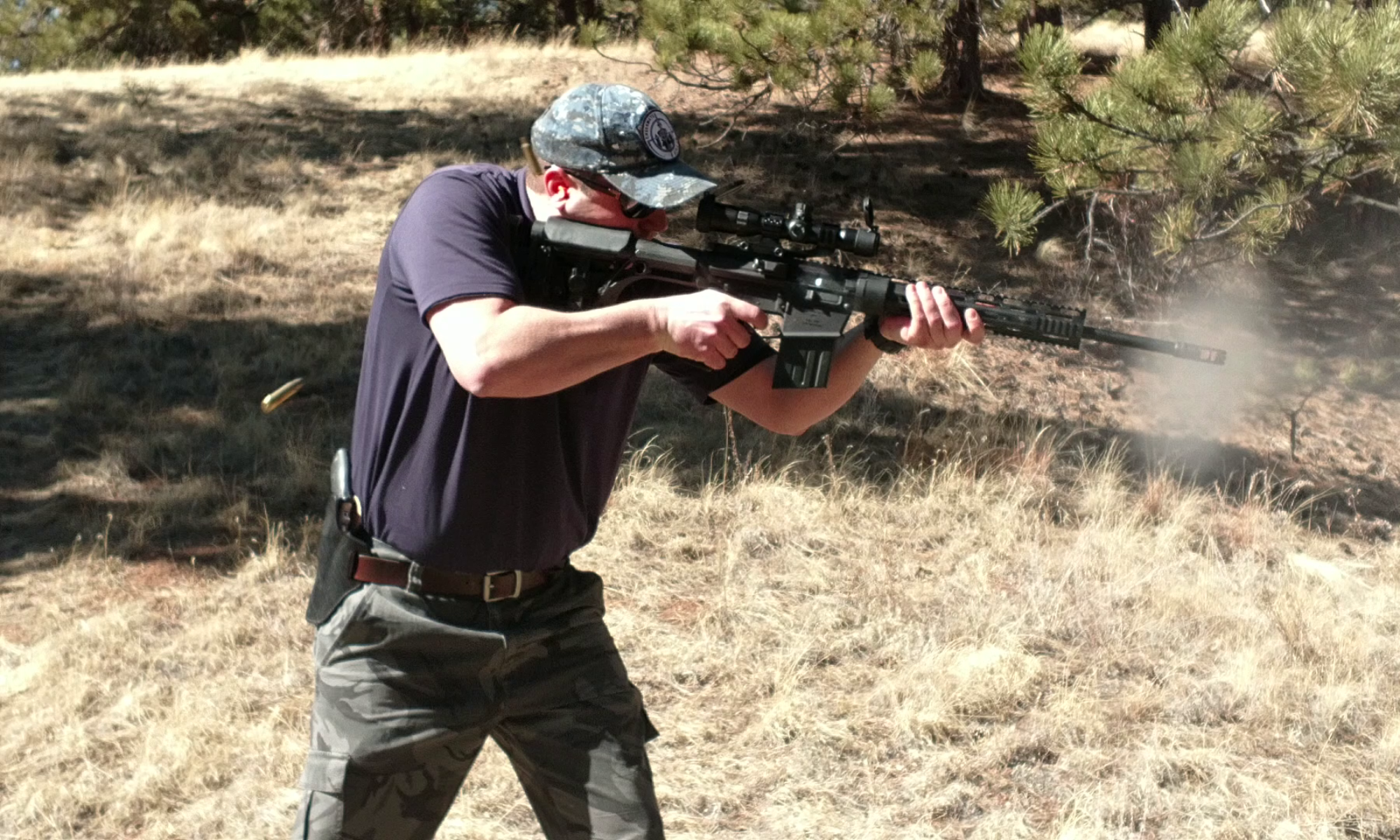
The 3-Gun and What’s Important (Part 1 of 3)

by David Weaver


The 3-Gun sport has become more popular than ever. New shooters are being introduced to the sport every day as are new rules and regulations as well as increased complexity of courses. The customization of firearms is reaching an apex; “what’s best” is a common and completely arbitrary question.

I get a lot of questions about 3-Gun rifles, and what’s important in a build. I have put together some information on what I think is important, and why. If you look to the top athletes of any sport, you will see patterns in gear and training techniques. Shooting is no different; increasing performance is paramount. Most top competitors run the same type of guns with the same types of equipment, by different makers.  It’s a sport like any other, the equipment is specialized. But really, what good is a football outside of a football game?

Here is what I think is important for the beginner in the Three Gun arena:

Upper and lower receivers. This is purely user preference. No matter what you choose, billet, mil-spec or sport receivers you need to have confidence in your equipment. I see advantages in less weight with sport receivers versus more rigidity in billet style receivers. I think the weight of a billet receiver helps the overall balance of a longer barreled rifle; say 20” or more. With less than a 20-inch barrel, I prefer a mil-spec dimension or sport type receiver (slick-side with no forward assist). Just choose quality (meaning the fitment between Upper and lower receivers). This is not the place to be cheap. Don’t worry about a forward assist. (You never drive a jam home, you clear it). If it’s not going forward it’s for a reason.

Pistol Grip. You need a grip that fit your hand comfortably and keeps you from over fingering the trigger. You cannot judge a grip based on blogs or opinions. You cannot judge a grip based on holding it in your hand free of a rifle. You must, and this is a pain, buy multiple grips and try them out on a course (a short course is fine). If you are still having a problem with finding a mass-produced grip that works, you can use a “wrap” self-stick ace wrap around your grip to make it more comfortable in your hand. Avoid grips designed for right or left hand exclusively; There will be times you will have to transition from strong side to off side and back. Do not make the grip too large or too squishy, you should be able to touch your middle finger with your thumb around the grip at the most. A little smaller so you could cover the nail of your middle finger with your thumb would be better. Finger groves can help if they fit, hinder if they don’t. The idea is to get maximum surface contact with your hand. Every square mm counts. Traction is what helps keep consistency during recoil. Consistency is control. Length of pull to trigger. Build up or shave down your grip (have a pro do it for you) so that your finger lands where it is supposed to naturally. If you look at the palm your hand as you bend your trigger finger. you will notice that the pad where the finger attaches to the palm swells as the finger is drawn in. Try to find a grip that does not force contact to this portion of your hand, for both hands.

The forend is our next point of focus. You want your forend to be long enough to properly employ the C-Clamp or Modified C-Clamp grip. This is easier with narrower forends. Free floating is the best for accuracy and allows you to go beyond the gas block. The farther out you can hold the better, so 15 inches or more. A forgrip is also a good idea, I personally do not use them to hold onto, but as supports in various positions. Whether you favor the forgrip as a grip or support, it’s essential for modularity. You will need an attachment point for your forgrip and a quick detach sling hook up on the forend is advisable. If you prefer to not grip the forgrip, I recommend putting grip tape on your common grip zones. It will allow you to maintain more consistency in grip during recoil. If you use full length picatinny rails, put ladders in them. You want to make sure that the rail you select has lots of ventilation, you want lots of air moving around the barrel. When you start shooting consecutive shots, things heat up quickly. Be sure not to hold the forend too close to the gas block. I have gotten burned by the aluminum forend heating up from the radiating heat from a steel gas block. I like a full length top rail for rigidity and small attachable rails for the rest of the forend.

Butt Stocks are very important. You won’t see too many top ranked competitors with bulky or heavy butt stocks. I like the underside to be as trim as possible. Lighter and less to snag or drag on gear. A quick detach point for a sling is again advisable. This can be a fixed/adjustable stock (like the Luth-AR MBA Stock) provided that the length-of-pull is correct for you. A fully adjustable six-position stock should lock into place without wiggling(like the Rogers Super Stoc). Keep in mind the slightest movement of 1/16” at your shoulder is inches and feet down range so you want to come up to position the same every time. You must have an aggressive no slip butt pad, so the rifle will not be as apt to move during recoil. While having battery compartments may be a good idea in your other rifles, not this one. Keep it trim. With the AR, you will want to set the comb height for your cheek, so that your eye naturally and automatically lines up with the optic. Make sure this does not affect your secondary tip off sight system. (see below)

Optics. There is nothing more personal than an optic in any of the 3-gun disciplines. Sights and optics are going to play a pivotal role in your success. When it comes to optics you will want a primary site that is fast to focus with a large field of view. That means lower powered scopes like 1-4x and 2-7x. I think 3-9x is too much on the bottom. The 3x magnification is too powerful for close, fast shooting. But some would argue that this is why we run with a canted sight set. They are correct. You can choose to put a halo sight or iron sights on a 45-degree canted mount. The advantage is that the sight on the canted mount will be sighted in at closer distances and that you will not have to look through a scope. The halo sight has a definite advantage over iron sights in the first 300 yards. With the halo, you do not have to line up two points to aim, just make sure you turn it on and put the dot on target then squeeze. There are two classes of canted mounts. In line and off axis. Most do not tell you what they are on the package. We want in line whenever possible. However, if you have to use a comb riser to fix cheek weld, you may need to use an off-axis mount.

Beyond that, you pretty much can’t go wrong with the one-piece scope mounts. Parallax free scopes, no less than 1/4 moa dials. I like 1/2 moa myself. If we must make a dial adjustment in a match we want to count the clicks, less clicks, less effort, easier to remember your way back to zero. Fast zoom is going to be a factor in longer supported shots. Put a lever on your zoom ring so that you can get the magnification up and down quickly with less effort. If you can get a cantilever one-piece mount you shouldn’t have any problem with eye alignment or relief. Otherwise you want to get set up so that you are instantly in focus when you take a firing position. Take extra care to mount your scope level. Choose quality mounts and optics. Have a professional install them, spend some time at the range to zero the scope; take notes then memorize the positions for different ranging. You won’t have time to think about it on race day. (unorthodox testing to see if you hold zero, use your imagination, you will want to know if you bang your scope during competition it will stay on zero)

Accessories, like the Mag-pul Bad Lever, Yep, buy 2. When the first one breaks, install the spare. If you use the lever it will fail on you eventually. But worth every penny 10 times over. And it’s not going to break easily. The one on my rifle has been there for a year or so with vigorous use. It will make reloads faster and smoother. It will make the end of run “make safe” easier as well. In a game where timing is everything and thousandths of a second stack against you, every advantage counts.

Barrel Length is up for debate. The 18.5 inch is very popular among top competitors. I prefer a 20 inch barrel, but the 18.5 makes a lot of sense. The 18.5 inch barrel plus a muzzle device is about 20 inches giving you the ballistics you need to make the longer shots, while staying compact enough for closer engagements. Keeping in mind that modularity is key in this game, we want less mass in front of our support hand during fast close quarter engagements; and we want enough muzzle velocity to give us a 5 foot or so drop at 500 yards. Preferably less. The H-Bar with fluting is going to be the best choice for contour. A bull barrel is always too heavy, even when fluted. While the thinner barrels are just too light. They heat up too fast and don’t offer the same balance characteristics of the H-Bar. The Type of fluting isn’t important, whatever jumps out at you and feels right. Needs to be match grade and made of 4142 steel (for heat dissipation) with chrome lining, or a 4150 CRMV with chrome lining. Ask about the process of chrome lining from your barrel supplier, there are different methods of chrome lining and I only know of one company in the United States that will remove material before applying the chrome to build it up again. This is the only way to avoid a “break-in” period that will ultimately cause hours of frustration at the range and “shooting out” of the chrome lining.  Buy two barrels at the same time if you know that is a barrel you can trust.

The muzzle device is one of the most important parts of this type of build. You will need to tame the recoil for faster, more accurate follow up shots. There are lots of great choices out there. Read their specs to get an idea of the recoil suppression rating. Choose the one you like with a high rating. Don’t get too caught up in the numbers, they are subjective. Just use them as a reference. The shape and direction the gas is redirected plays a big part in how well a muzzle device performs. Also keep in mind that it will add length and weight to the weapon. I like the King Comp and Checkmate brakes from Strike Industries.

The Fire Control Group and BCG of your gun are going to take some abuse. You want to start with a high-quality steel bolt and trigger group. You don’t want to have to leave a match unfinished because something failed under stress. Tried and true Carpenter 158 or 9310 bolts mated to an 8620 carrier with a 4000 series gas key. Absolutely under no circumstance should you go with anything that is metal injection molded (MIM) Check the specs. Military specification (mil spec) is strong but not where we want to be in the trigger pull and reset. You need a trigger that is crisp, with little to no creep (or slip) with a fast reset. It needs to be sturdy so we can control discharge and won’t have an accident if the weapon is dropped. I like a 3.0-4.5 lb break weight with a short positive reset (velocity triggers are my go-to). The reset should be the same as the initial set. I have fired guns that had a mil spec initial set from the bolt being pulled back, to a reset that was barely there. This makes it difficult to pull the trigger the same every time, because it’s not the same every time. As a rule the maximum trigger break weight should not exceed the weight of the rifle naked (with no accessories). This helps with control. As a rule, for rifles that are going to be used vigorously that could get dropped or slammed or jarred somehow. Do not go below 3 lb trigger break weight. A 3 lb or greater trigger break weight is usually enough resistance that the shot must be intentional, and wont discharge from being jarred. Safety first.

Little things make big differences, good or bad. User ergonomics are what’s going to win out in the end. Keep in mind that this is a very psychological game. You must have confidence in your equipment and ability to use it. Follow the guidelines above and your only problem will be catching up with the guys already doing it. Chances are, they will help you get there.

by David Weaver aka Hunter Morbid for Checkmate Rifle Company

AR-15 Cartridge Comparison

The AR-15 has long-been established as America’s most popular civilian rifle. With endless customization possibilities and caliber options, it’s easy to get overwhelmed by so many choices. What is really important is that we know what to expect from our rifle. What are you going to do with it? The most popular uses for an AR-15 are competition, hunting, precision, sporting, and varmint; any of which could make use of a variety of caliber options. Do you ever wonder what the differences between rifle cartridges really equate to?

Competitive Shooting

Competition rifles are usually built for speed and accuracy.  3-gun shoots have exploded in popularity, and demand versatility of the shooter and his or her rifle.  A wide variety of targets, shooting positions, and engagement ranges will test a competitor’s speed and accuracy in very different ways. While there is a wide range of what works and a general attitude of “run what ya brung” in this community, a lightweight and low-recoil setup that is accurate at variable ranges may be best.  Typically, shooters in this category use a .223 caliber setup for it’s low ammunition cost and excellent accuracy.

Big Game Hunting

Weight, energy, effective range, and accuracy are very important in a hunting rifle. I will probably be carrying the rifle on my person while I hunt, so I want my rifle to be accurate and light so that I can make the shot count, when it counts. Some states have a minimum energy requirement you may need to meet.  Personally, I want 5 ft. or less drop at 500 yards with a muzzle energy below 1500 ft/lbs. for better control. I want to deliver to my quarry a minimum amount of energy in ft/lbs. equal to its weight in lbs… So for a 400 lb. Animal, I want a minimum of 400 ft/lbs. at target.  Down range energy is an important factor in determining maximum effective range. Another factor is bullet construction vs. velocity. Hunting bullets are designed to expand at controlled velocities. So it is important that we know the performance range of our bullets and the velocities that our rifle produces. My favorite hunting bullet in .30 cal requires an impact velocity of 2200 fps or faster to work as designed. I make sure that my target is close enough that I will still achieve that velocity.

Precision Target Shooting

Precision rifles are built for shooting tight groups on paper. They tend to be big, heavy, and shot from a bench rest. They favor fast cartridges or heavy bullets, depending on what you intend to do. A precision rifle for shooting at 100 – 300 yards will favor lighter, flat based bullets at higher velocities. While a precision rifle built for long range shooting would more likely favor heavy boat tail bullets that are not as fast. Typically these rifles would run the 204 Ruger or .223 Remington.

Varmint/Small Game Hunting

Varmint is its own class of precision rifle meant to shoot small critters from reasonable distances. A varmint rifle is typically heavy with a longer than standard barrel that will be chambered in one of the faster cartridge choices.  Similar to a precision target rifle, this setup will usually be chambered in .204, .223, or similar cartridge.

Sporting Rifles

Sport rifles are your run of the mill, let’s go shoot type guns. They are good all around guns that tend to be on the lighter side. This type of rifle will run in a competition and hit reasonable sized targets at a reasonable distance. Basically, its built for plinking and ease of use and carry. The most popular caliber for this purpose remains the .223/5.56, however the 7.62×39 AR is being used more and more by plinkers due to it’s low ammunition cost and increased energy on target for additional fun-factor.

Data Comparison

Have a look at the tables and notes below to gain some perspective. Keep in mind that the data presented is an estimation based on common conditions in Colorado and depends on many factors.

The bullet weight/type is the load. When you buy a box of ammo it will have a weight (wt.) in grains (gr.) and bullet type like full metal jacket (fmj) or hollow point boat tail (hpbt). These are just what I used for the table, and I did not get into brand specifics. The zero is where the bullet impacts exactly on sight. I used 100 yards as a control for bullet drop and wind comparison. Muzzle velocity is how fast the bullet exits the barrel and is measured in feet per second(fps). We use this to see how fast the bullet slows down. Muzzle Energy is a reference for recoil and will be used to see how fast the bullet sheds energy. The energy is given in foot pounds (ft/lbs). The wind effect at 400 – 500 yards @ 10 mph is how many inches the wind pushes the bullet if the wind is 10 mph and directly perpendicular to the direction of the bullet. Drop @ 400 – 500 yards tells us how far the bullet falls in inches, or how high you have to hold over your target to hit. Velocity @ 400 -500 yards lets us know how much velocity we have remaining, as with energy remaining @ 400 – 500 yards.

I mentioned recoil, but there is no recoil energy listed in the tables. To help us rate the recoil of a cartridge, we look at the muzzle energy. More energy means more recoil. It is the nature of physics. Luckily, recoil can be tamed with a number of muzzle devices on the market today. A muzzle break can reduce recoil up to 70%. and makes your report louder at the shooter.  A suppressor will reduce recoil and quiet your report while adding weight and length to the rifle. Just know that you will not eliminate recoil completely.

With what we expect in mind, lets look at some data.

High Velocity/Small Bore Calibers

204 Ruger

Currently the fastest production cartridge on the market. Purpose built as a varmint cartridge with explosive energy and a flat trajectory. With an amazingly low recoil signature, you will be shooting this rifle accurately all day long. The only drawback is that the ammo can be expensive and hard to find relative to some of the other cartridges available in the AR-15 platform. As you would expect, these rifles tend to be extremely accurate.

223 Remington

A favorite of varmint and target shooters. The general consensus is that the 223 Rem. is a more accurate chambering than the 5.56×45. Most 223 Rem. have a twist rate of 1:14-1:10 to better stabilize the lighter than 55gr bullets. Therefore, most of your ammo is 55gr or less. The ammo is affordable and can be found just about anywhere ammo is sold. The reason that the 223 Rem. has become less popular in the AR platform is that the 5.56×45 NATO cartridge has the same external dimensions as the 223 Rem. and will chamber and fire in a 223 Rem. So what’s the difference? Pressure! The 223 Rem. has a maximum safe operating pressure of 55,000 psi. While the 5.56×45 NATO has a maximum safe operating pressure of 62,350 psi. That may not seem like much, but it’s an 11.8% increase in pressure. DO NOT FIRE 5.56×45 in a 223 Rem.

A note on the 223 Wylde Chamber

Designed to get the most accuracy out of a 5.56×45 safe chamber. This has become a very popular choice for anyone who wants the potential accuracy of a 223 Rem. with the versatility of a 5.56×45.

5.56x45NATO

This is the American military rifle chamber. Typically comes with a 1:7-1:9 twist to better stabilize bullets in the heavier than 55gr variety. This is the most common AR-15 chamber. Ammo is readily available and affordable, making it a great choice for training,plinking, or competitive shooting. Keep in mind that you can safely shoot 223 Remington, so ammo is everywhere.

High Velocity/Small Bore Data Chart

Chart1.jpg

Mid-size Calibers

6.5 Grendel

Purpose built for accurate, long range hitting power from the AR-15 Platform. This is a popular and in demand little cartridge. At 800 yards, the drop is around 200 inches with a little over 500 ft/lbs of energy. The 5.56×45 62gr drops around 165 inches at 800 yards, but has less than 300 ft/lbs of energy. The drawback is cost per shot. Being purpose built for distance shooting, most ammo manufactures use premium bullets to make high quality ammo.  Even the more affordable FMJ ammo is of high quality, so there is no reason not to shoot well.

6.8 SPC

To over simplify, this is an American answer to the 7.62×39 Russian. It has energy equivalent to the 7.62×39 Russian, but faster and flatter for more distance. This cartridge will match the energy of the 7.62 to 500 yards, but with 2ft less drop. Due to the superior bullet construction, this is a better choice for hunting, target, and most competitive shooting. But as you would expect, the cost per shot is also higher.

300 AAC Black Out

Not to be confused with the 300 whisper, this is a purpose built cartridge for a suppressor. There are two faces to this cartridge. The supersonic side will push the lighter than 150gr bullets at over 2000 fps making it a great choice for hunting or fast action shooting. While the sub-sonic side can deliver a greater than 200gr bullet to 300 yards with 400+ ft/lbs of energy (that’s 45acp energy). If you want quiet, this is probably the most quiet suppressed center fire rifle round when using sub-sonic ammo. It’s no surprise that hunters have taken to this cartridge for its ability to put down medium sized game quickly, with fast follow up shots if necessary.

7.62×39 Russian

The Russian designed equivalent to the American 30-30 WCF, but with a spitzer bullet and made more compact for automatic rifles. There are more powerful battle rifle cartridges, but this seems to be the standard by which all the others get judged. Many consider it to be the best compromise between recoil and power. It has a reputation for putting targets down quickly, although recoil is more significant than the faster, flatter 5.56×45 NATO. Ammo is on the cheaper side and readily available making this an excellent all around choice.

Mid-size Data Chart

Chart2.jpg

Big Bore Calibers

450 Bushmaster

Built for power, this is a hard hitter. If energy is your goal, this is your choice. A favorite of big game hunters, this will put down anything in North America. The down side to all that energy is recoil. It’s painful and even with a  muzzle device the recoil will cause significant muzzle rise, so faster shots can be challenging. It is still a lot faster than a bolt gun, probably even a lever gun.

50 Beowulf

Because bigger is better, and this is the biggest. This shoots a massive half inch diameter round or flat nose bullet to deliver high amounts of energy and deep penetration. Great for hunting larger and more dangerous game at close distance. The heavy bullet drops fast so long distance shots can be difficult.

458 Socom

This cartridge was inspired by special ops guys who wanted more stopping power, whether or not the weapon is suppressed. Using sub sonic rounds, this little cartridge can deliver a 600gr projectile with authority, and not much bark. With the supersonic loadings you get tremendous energy and effect on target. A favorite of medium and big game hunters, this cartridge stands out from the 450 Bushmaster and 50 Beowulf due to its bottleneck case design.

Big Bore Data Chart

Chart3.jpg

Conclusion

Again, the data above is an estimation based on common conditions in the state of Colorado. Many factors play a part in how bullets perform. Although the data is accurate, it is for reference only.

In parting, I would like to reiterate that firearms are purpose built, to serve a need. Get the right tool for the job. Many universal tools work very well, but having the right purpose built tool often makes the job easier. Thank you for taking the time to visit us. Our goal is to bring you the information you need to make an informed and educated decision. Have suggestions or questions? Please, let us know.

By Hunter Morbid and Checkmate Rifle Company

“There are no bad guns, only better ones.”

Checkmate Rifle Company’s New Web Store

Visit Checkmate Rifle Company’s new online store.  Please continue to check back for new AR-15 and AR-10 related products being added soon.  Right now we have some excellent pricing on premium barrels, nitride M-16 bolt carriers, as well as our free float lightweight keymod handguards.  All are excellent quality American-made AR parts at great prices.  We are committed to offering the best quality AR parts at the best price and we know every part we offer will be the best quality you can find at that price point!

We will be adding our own top-quality complete barreled upper assemblies soon, along with stripped lowers and complete lowers.  These will be your ticket to building a badass rifle for a wimpy price!

Happy Shooting,

Checkmate Rifle Company

https://checkmateriflecompany.com/